What is the biggest IT challenge facing businesses today?
Is it the continual flux in the IT market, and the future of major players? Is it the move to On Demand and how this is creating tectonic shifts in IT organisations? What about the increasing virtualisation and distribution of businesses, and the threats and opportunities this creates for changing business processes?
These are all big questions, but for me, as I look at what happens when business and IT get together to try to develop a strategy for IT in business, the biggest single issue that is faced in every sector, in every market and for organisations be they large or small, is the degree of disconnect between the most senior people in the business and their IT organisations and suppliers.
Aside from the CIO, the CxOs are for the most part uncomfortable with IT, and range from being wildly over-confident that the coding wizards can perform a magical transformation, or deeply mistrustful that they are being oversold another white elephant. Mostly, they are just sceptical about the promises of IT and give it as little time as they can get a way with: IT is a necessary but not enjoyable part of doing business!
I have a picture I use that seems to resonate with business and IT when I talk to them. I call it ‘The Discomfort Zone’.
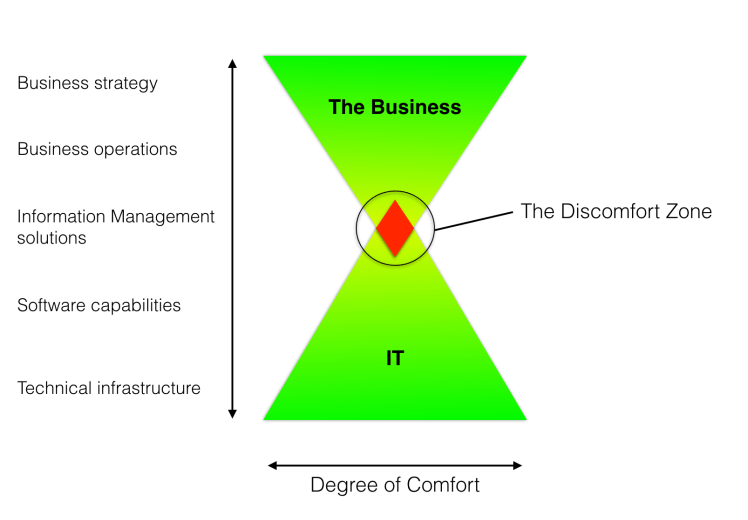
My hypothesis is that, on the one hand, the closer that senior management get to IT questions, the less comfortable they feel (they may even resent being put in a position where they feel a lack of understanding and therefore of power). On the other hand, the closer IT get to business strategy, the less comfortable they feel. In the accompanying figure, we see that the area of overlap is then represented by a small red diamond: The Discomfort Zone.
The area of ‘information management solutions’ is precisely where the business’s understanding of its information combined with IT’s understanding of the ‘Art of the Possible’ ought to come together creatively, to explore opportunities for innovation. The fact that too often they do not, is a major issue.
Many opportunities, for example in the banking sector, to innovate and improve business processes, never get discussed substantively at CxO level. The Board is discussing critical questions like capital adequacy requirements, while IT is lost in the features and functions of its shiny new Enterprise Integration Architecture, and the poor folk running the business processes have a legacy of information silos that make it impossible to serve their clients efficiently: “Hi, remember me!?”, they could be forgiven for asking.
How often has a senior management discussion with IT descended into a narrow discussion about costs, or even merely the rate card for techies on the project, as though that was the difference between success and failure of the change programme.
The assertion that we live in a ‘knowledge economy’, where one would expect the importance of IT to be discussed in terms of its value to the business, often looks hollow. The dumbing down of the conversation is a direct result of the failure to create a shared language, to enable a shared vision for a major transformation, that both the CxO and IT can understand, and devote time to.
Of course, for those that only looked at costs and not at the vision, or its value, the nasty surprise is that it didn’t turn out cheaper. The law of unintended side effects bites again.
I know of a bank that spent $10m on what was supposed to be a transformational project. They wanted to become more agile by using ERP (Enterprise Resource Planning) as a platform to define and deliver new services (something that took many months with their old processes and systems).
They would use the new ERP ‘off the shelf’ with some configuration, and adapt their processes to deliver the transformation. What happened was quite different.
The staff in the business and the outsourced developers instead created a kind of parody of the old system, while senior management had somehow lost interest in what was actually being done. The day rates were cheap but they took an enormous number of days bespoking an un-supportable, un-upgradable behemoth that looked surprisingly like the old one they were supposed to be throwing away.
An informed Board, or dare I say one that was intellectually curious, would never make that mistake.
Much of the effort that I think is important, when engaging the business and senior management, is to eliminate the Discomfort Zone by increasing the area of overlap between the business and IT, by developing a realistic and shared understanding of the art of the possible. This will involve many discussions on what ‘success’ will realistically look like and how to get there. It is not merely about creating a prototype, but forensically understanding the incremental effort involved in implementing each process within the business.
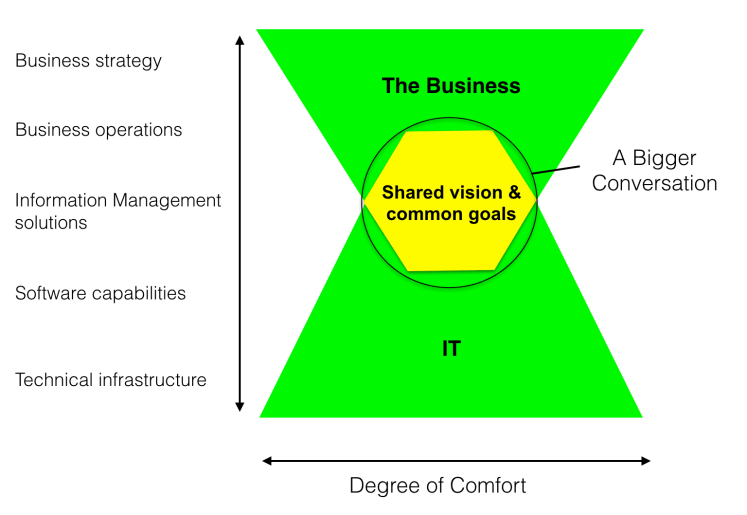
This requires mutual and sustained commitment during this exploratory phase, and a genuine attempt to test ideas, rather than relying on Powerpoint and fine words. It is not just “The What” but also “The How”.
Never ask the question “can it be done?”, because the answer is always “yes!” (and the myth is that with a suitably smart bunch of ‘coders’, literally anything is possible; theoretically yes, in practice, no. Coding is the easy bit: having a fit-for-purpose vision and blueprint is the hard part).
This is not about glossy Powerpoint, but about a genuine understanding of the art of the possible. The intention and commitment of the Board should be to create a shared vision and common goals based on reality, not on wishful thinking.
When organisations spend the time needed to develop such a shared understanding, they greatly increase their chance of achieving the business transformation they seek.
(c) Richard W. Erskine, @ContentRich
Disclaimer: The blog post is adapted from a version I previously publish on ThoughtFeast, under the auspices of Dell EMC. Both the original post and the current one solely reflect the views of the author, and do not purport to convey the views or intent of Dell EMC.
 ContentRich